AI Is Badly Named: It’s Actually CKE: Collective Knowledge Engine
Aug 2026
There’s something about the expression “Artificial Intelligence” that bothers me.
Not because the technology isn’t impressive. Quite the opposite. It’s probably one of the most impressive things we’ve ever built as a species.
What bothers me is that, for now, the name describes rather poorly what we actually have in front of us.
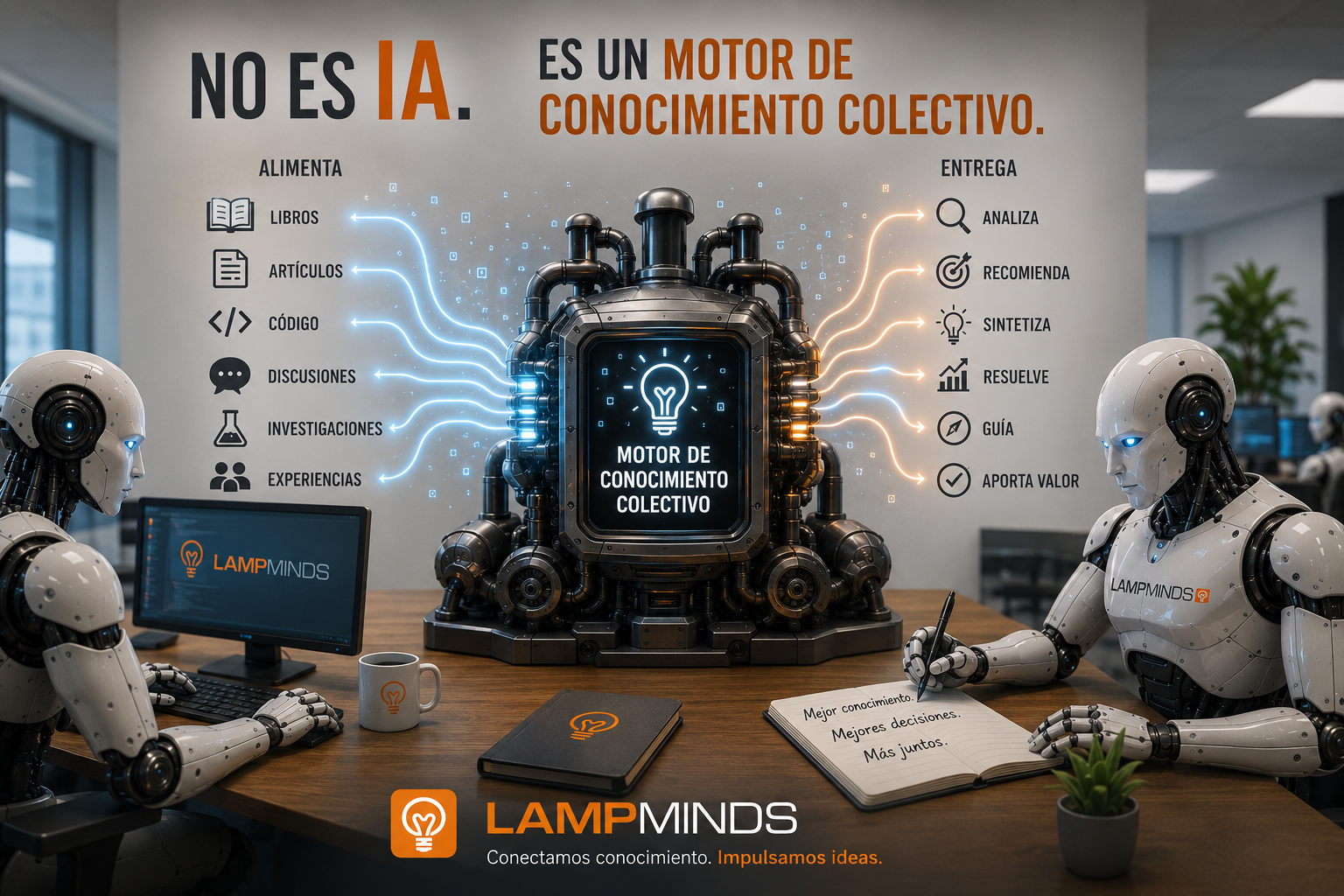
We’re not really looking at an artificial intelligence. We’re looking at a gigantic engine for collective knowledge.
If I had to name it from scratch, I’d call it CKE: Collective Knowledge Engine.
And yes, I know CK already means a bunch of other things. But let’s not pretend humanity has always been particularly good at naming technology. “Personal computer,” “smartphone,” “artificial intelligence”… We’re remarkably creative when inventing things and surprisingly unimaginative when naming them.
The machine that seems to think
Let’s try something.
We ask an AI system:
“How can I improve the productivity of a team of software developers?”
And it gives us a fairly reasonable list: define clear objectives, reduce unnecessary meetings, automate repetitive tasks, use version control, conduct code reviews, establish priorities, measure results, and so on.
It can even explain why each of these things works.
And we think:
“Wow. That’s intelligent.”
But let’s ask a second question:
“What management methodology should a team of software developers use in a civilization that has never existed before, with an economy based on interplanetary travel, instantaneous communication, and organizations run by species we’ve never encountered?”
Now things get interesting.
Because the system can invent an answer. It can combine concepts. It can extrapolate. It can create something that sounds perfectly convincing.
But there is a huge difference between generating a new answer and discovering new knowledge.
The first one it already does remarkably well.
The second is a different story.
The real superpower is everything we’ve already done
The raw material of these systems is, essentially, the enormous volume of knowledge produced by human beings.
Books.
Articles.
Research.
Documentation.
Code.
Conversations.
Experiences.
Mistakes.
Discussions.
Opinions.
Methods.
Theories.
Success stories.
Failures.
And billions of examples of how human beings describe, explain, connect, and reason about things.
For centuries, each generation built upon the previous one.
One scientist read another. One programmer learned from another. A doctor studied thousands of cases. An engineer learned from structures that had failed. An entrepreneur copied a strategy that worked somewhere else and adapted it.
The difference is that we had a rather significant problem:
our brains have limits.
We can’t read ten million books.
We can’t remember twenty thousand research papers.
We can’t simultaneously analyze every solution that has ever been proposed for a particular problem.
And our mental search engine isn’t particularly good either.
AI, on the other hand, can work with an amount of information that no individual human could ever process.
That’s where one of the real revolutions lies.
Not necessarily in having created a new intelligence.
But in having created a tool capable of exploiting, collectively, an enormous portion of the intelligence we have already generated as a species.
A library that can talk back
For a very long time, we had libraries.
Then we got Google.
Google allowed us to find information.
But we still had to do something with it.
We had to read.
Compare.
Interpret.
Connect.
Think.
And then draw our own conclusions.
Today’s systems add something completely different: a conversational interface capable of synthesizing, connecting, and reformulating knowledge.
We no longer have to ask:
“Where can I find information about X?”
We can ask:
“I have this problem. What should I do?”
And the system can, implicitly, navigate an enormous amount of related knowledge and return an answer that seems to have been created specifically for us.
That is extraordinarily powerful.
But it’s also quite different from saying that we have built a machine that “thinks.”
Can AI discover something nobody has discovered?
This, to me, is the interesting question.
Let’s suppose that tomorrow we give an AI absolutely everything humans know.
All of physics.
All of mathematics.
All of biology.
All of engineering.
All of literature.
All of code.
All of research.
All of experiments.
All of failures.
And we ask:
“Discover a completely new theory about a phenomenon no human being has ever discovered.”
It can produce a hypothesis.
It can combine theories in ways no researcher has thought of before.
It can find relationships we missed.
It might even suggest something that turns out to be true.
But there is still a fundamental difference.
A hypothesis is not knowledge.
To become knowledge, it has to be tested against reality.
And there’s something that AI still can’t solve simply by processing more text: the real world.
A theory of physics doesn’t become true because an AI wrote it beautifully.
A new drug doesn’t work because a model found a statistically interesting combination.
An algorithm isn’t better because the AI says it is.
Reality still has the rather annoying habit of refusing to accept our answers simply because they’re well written.
AI can combine pieces in extraordinary ways
Now, I don’t want to fall into the opposite extreme either.
Saying that AI works with human knowledge doesn’t mean it’s simply doing “copy and paste.”
That would be like saying a composer creates nothing new because all the musical notes already existed.
Today’s systems can combine concepts in ways that weren’t explicitly present in any particular document from their training data.
They can find analogies.
They can transfer concepts from one field to another.
They can take a technique from one discipline and apply it to another.
They can generate unexpected solutions.
They can write code.
Design structures.
Propose hypotheses.
Simulate scenarios.
And, in some cases, they can find solutions that humans hadn’t found.
That is enormous.
But perhaps the right word to describe it isn’t intelligence.
Maybe it’s something closer to the ability to synthesize and explore accumulated knowledge.
And that’s not a small thing.
In fact, it may be much more interesting.
Collective knowledge as a multiplier
Imagine a programmer.
They have ten years of experience and know Laravel, databases, Linux, and a few other technologies reasonably well.
They’re a good professional.
But they’re still one person.
Now imagine that programmer can instantly consult a sort of collective memory built from decades of experience accumulated by millions of programmers.
They can ask:
“I have this architectural problem. What approaches are available?”
And receive five different strategies.
They can ask:
“What are the problems with this design?”
And get a list of objections.
They can ask:
“How would someone experienced with highly concurrent systems approach this?”
And get another perspective.
The machine isn’t necessarily replacing the programmer.
It’s doing something much more interesting:
it is amplifying the individual’s capabilities with collective knowledge.
And this can apply to virtually any profession.
A doctor.
A lawyer.
An architect.
A teacher.
A researcher.
A journalist.
A designer.
An entrepreneur.
A student.
Everyone can now access something that, until very recently, was impossible:
an immediate conversation with a compressed representation of a gigantic portion of human knowledge.
So, what exactly is “intelligent” about it?
Here’s where the philosophical discussion begins.
Because we’re entering territory where the definition of intelligence itself becomes uncomfortable.
Is something intelligent if it can solve a problem but doesn’t really know what it’s doing?
Is something intelligent if it can write a poem but cannot feel anything?
Is something intelligent if it can explain the theory of relativity but has no experience whatsoever of the universe?
Is something intelligent if it can outperform humans at certain intellectual tasks while simultaneously making absurd mistakes?
The answer depends, to a large extent, on what we mean by intelligence.
But there is an important distinction:
being capable of producing intelligent results is not necessarily the same as possessing intelligence comparable to human intelligence.
And perhaps we still don’t know exactly where one ends and the other begins.
The day AI creates genuinely new knowledge
Maybe it will.
In fact, it probably will.
And when that happens, the name “Artificial Intelligence” may start to make much more sense.
A machine capable of formulating a theory about something nobody knew, designing an experiment to test it, carrying out that experiment, interpreting the results, modifying the theory, and repeating the process until it discovers a completely new truth would be doing something much closer to autonomous scientific research.
That would be qualitatively different.
But we’re not there yet.
Today, most of what we do with these systems consists of asking them to do something using knowledge, patterns, methods, and experiences that ultimately came from us.
AI didn’t invent programming.
It didn’t invent medicine.
It didn’t invent accounting.
It didn’t invent literature.
It didn’t invent physics.
It didn’t invent marketing.
It didn’t invent humor.
It didn’t even invent the mistakes it makes.
It inherited all of them from us.
What it has now is the ability to mix them at a speed and scale no human being can match.
Maybe we should feel a little less threatened
This also changes how we should think about our relationship with AI.
If we see it as an extraterrestrial intelligence that suddenly appeared to replace us, it’s perfectly reasonable to panic.
If we see it as a gigantic engine for collective knowledge, the story looks very different.
Suddenly, the most powerful tool we have ever built isn’t necessarily competing against human knowledge.
It is built on top of it.
And the better the knowledge we put into these systems, the better the tools we have for working with it.
There’s something almost poetic about that.
For thousands of years, every generation wrote things that ended up in books, documents, libraries, and computers.
Now we are building machines capable of navigating a huge portion of all that and giving us an answer in seconds.
Humanity is beginning to have a conversation with its own memory.
And perhaps that is far more interesting than simply saying we invented “artificial intelligence.”
Because, for now, the intelligence is still ours.
The machine simply gave collective knowledge an engine.
And that engine runs very, very fast.
P.S. The reader might be thinking, "Is this AI-generated?" The answer is YES, but it's based on my own idea. If my idea hadn't existed, this article wouldn't have been written, right? So, who is the real author?
Gabriel Schillaci